MiniMax-M2.5
A large agentic model built for coding, tool use, search, and office work, reporting strong results on SWE-Bench Verified and other agentic benchmarks.


MiniMax M2.5
Summary
Introduction
MiniMax-M2.5 is MiniMax's latest model in the M2 series, trained with reinforcement learning across hundreds of thousands of complex real-world environments and built for coding, agentic tool use and search, office work, and a range of other practical tasks.
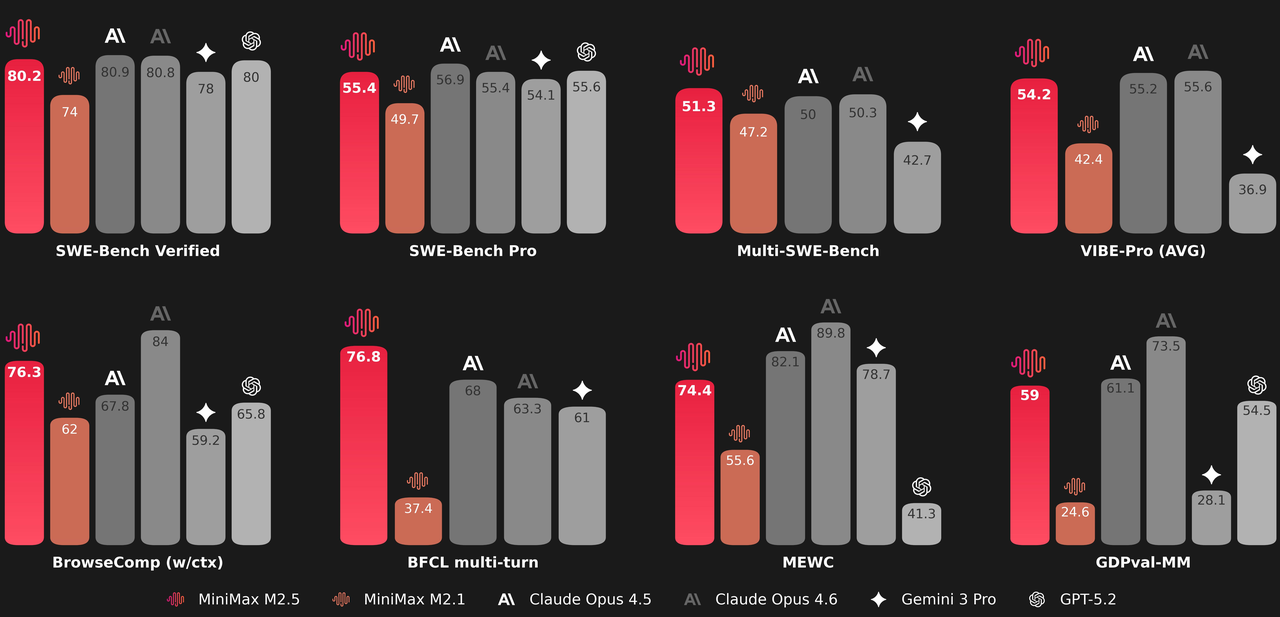
MiniMax reports the following results (self-reported): 80.2% on SWE-Bench Verified, 51.3% on Multi-SWE-Bench, and 76.3% on BrowseComp (with context management).
Trained to reason efficiently and decompose tasks well, M2.5 is also fast on complex agentic work — MiniMax reports completing the SWE-Bench Verified evaluation 37% faster than M2.1, on par with the speed of Claude Opus 4.6.
Coding
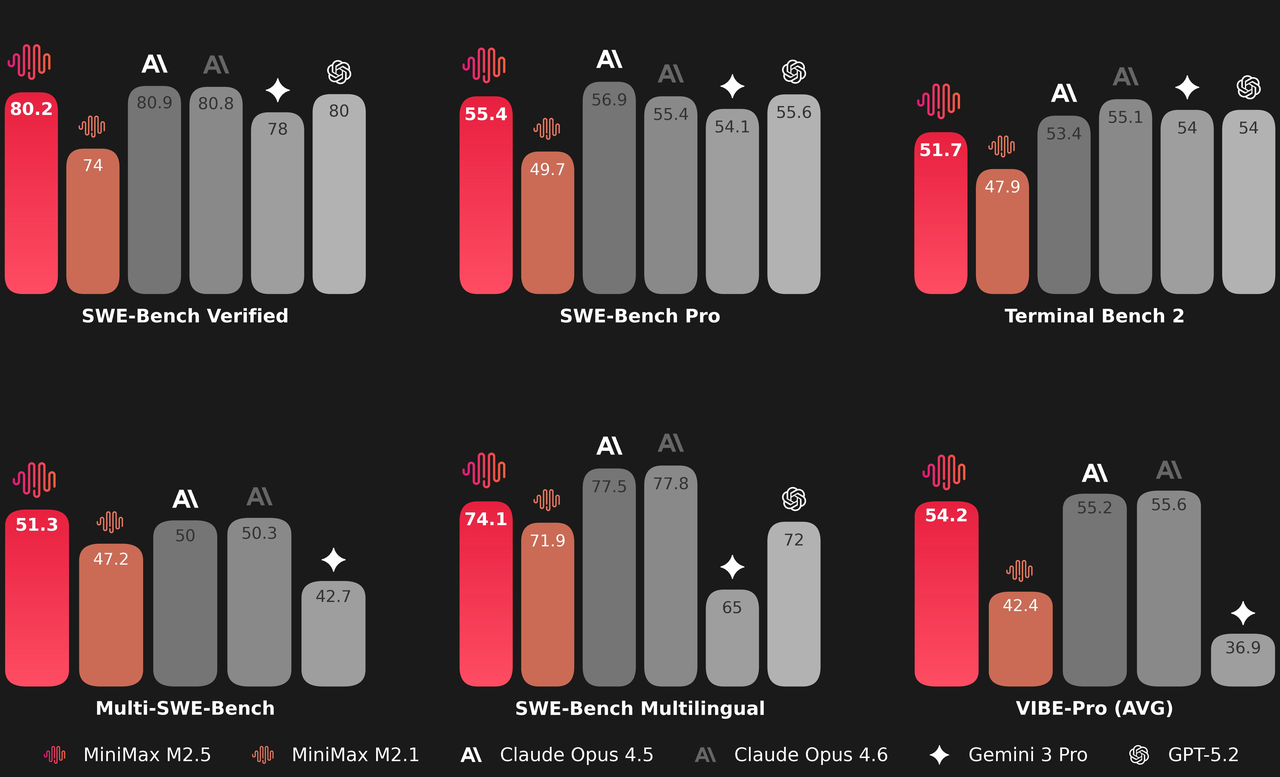
In programming evaluations, MiniMax reports substantial improvements over previous generations, with particularly pronounced gains on multilingual tasks.
A significant improvement from previous generations is M2.5's ability to think and plan like an architect. The Spec-writing tendency of the model emerged during training: before writing any code, M2.5 actively decomposes and plans the features, structure, and UI design of the project from the perspective of an experienced software architect.
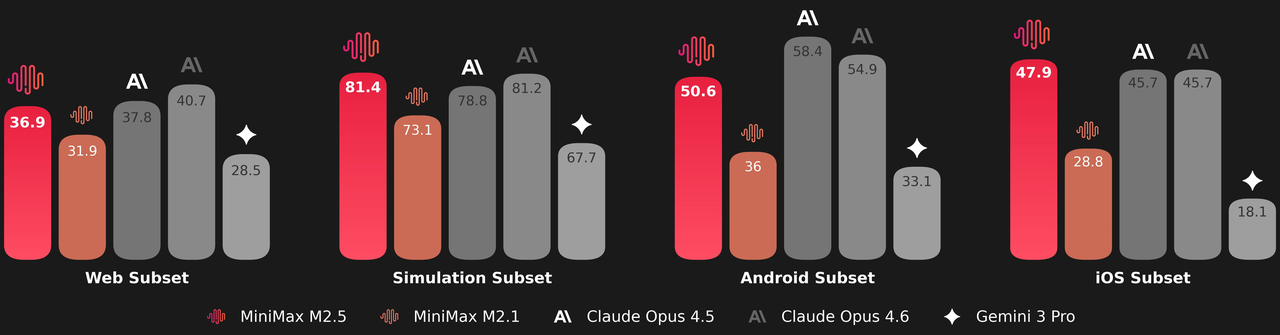
M2.5 was trained on over 10 languages (including Go, C, C++, TypeScript, Rust, Kotlin, Python, Java, JavaScript, PHP, Lua, Dart, and Ruby) across more than 200,000 real-world environments. Going far beyond bug-fixing, M2.5 delivers reliable performance across the entire development lifecycle of complex systems: from 0-to-1 system design and environment setup, to 1-to-10 system development, to 10-to-90 feature iteration, and finally 90-to-100 comprehensive code review and system testing. It covers full-stack projects spanning multiple platforms including Web, Android, iOS, and Windows, encompassing server-side APIs, business logic, databases, and more, not just frontend webpage demos.
To evaluate these capabilities, MiniMax upgraded its VIBE benchmark to a more complex Pro version, increasing task complexity, domain coverage, and evaluation accuracy. On this benchmark, MiniMax reports M2.5 performing on par with Claude Opus 4.5.
MiniMax also focused on the model's ability to generalize across out-of-distribution harnesses, testing SWE-Bench Verified performance with different coding-agent harnesses:
- On Droid: 79.7(M2.5) > 78.9(Opus 4.6)
- On OpenCode: 76.1(M2.5) > 75.9(Opus 4.6)
Search and Tool calling
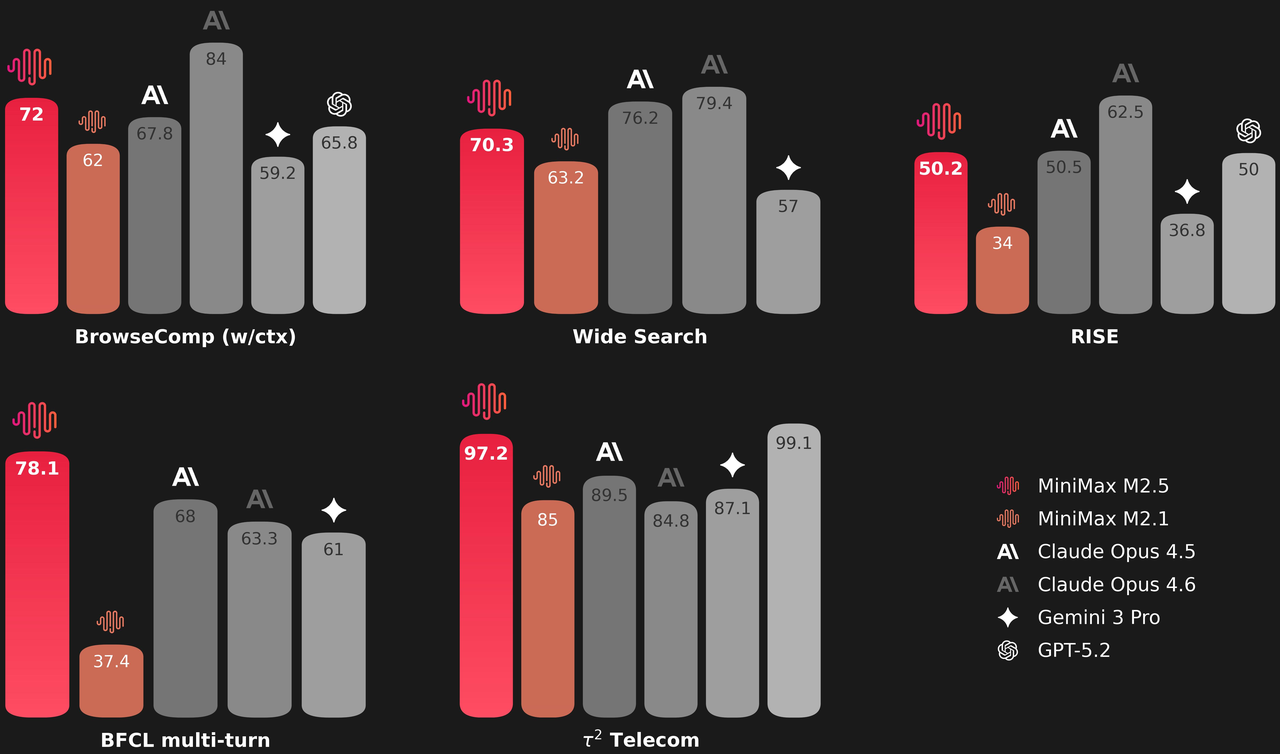
Effective tool calling and search are prerequisites for a model's ability to autonomously handle more complex tasks. In evaluations on benchmarks such as BrowseComp and Wide Search, M2.5 achieved industry-leading performance. At the same time, the model's generalization has also improved — M2.5 demonstrates more stable performance when facing unfamiliar scaffolding environments.
In research tasks performed by professional human experts, using a search engine is only a small part of the process; most of the work involves deep exploration across information-dense webpages. To address this, MiniMax built RISE (Realistic Interactive Search Evaluation) to measure a model's search capabilities on real-world professional tasks. MiniMax reports that M2.5 performs well on expert-level search tasks in real-world settings.
Compared to its predecessors, M2.5 also demonstrates much better decision-making when handling agentic tasks: it has learned to solve problems with more precise search rounds and better token efficiency. For example, across multiple agentic tasks including BrowseComp, Wide Search, and RISE, M2.5 achieved better results with fewer rounds, using approximately 20% fewer rounds compared to M2.1. This indicates that the model is no longer just getting the answer right, but is also reasoning towards results in more efficient paths.
Office work
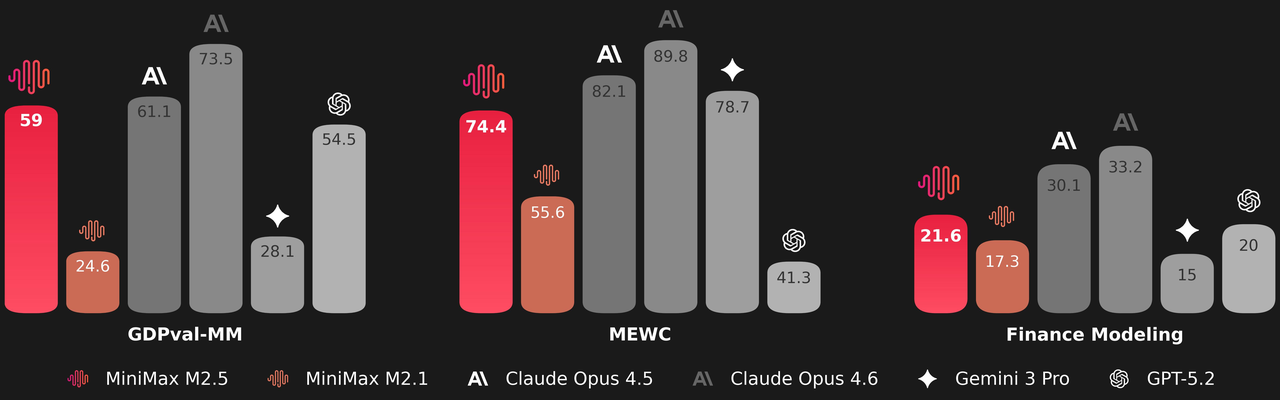
M2.5 was trained to produce deliverable outputs in office scenarios. To this end, MiniMax collaborated with senior professionals in fields such as finance, law, and social sciences, who designed requirements, provided feedback, helped define standards, and contributed to data construction, bringing the tacit knowledge of their industries into the model's training pipeline. On this foundation, MiniMax reports improvements in high-value workspace scenarios such as Word, PowerPoint, and Excel financial modeling. For evaluation, MiniMax built an internal Cowork Agent evaluation framework (GDPval-MM) that assesses both the quality of the deliverable and the professionalism of the agent's trajectory through pairwise comparisons, while also monitoring token usage across the workflow. In comparisons against other mainstream models, MiniMax reports an average win rate of 59.0%.
Efficiency
Task completion speed depends on a model's task-decomposition effectiveness, token efficiency, and inference speed. MiniMax reports that M2.5 is served at a rate of 100 tokens per second, and that its reinforcement learning setup encourages the model to reason efficiently and break tasks down well — together yielding meaningful time savings on complex tasks.
For example, when running SWE-Bench Verified, MiniMax reports M2.5 consumed an average of 3.52 million tokens per task, compared with 3.72M for M2.1. Thanks to improvements such as parallel tool calling, end-to-end runtime dropped from an average of 31.3 minutes to 22.8 minutes — a 37% speed improvement, on par with Claude Opus 4.6's reported 22.9 minutes.
Improvement Rate
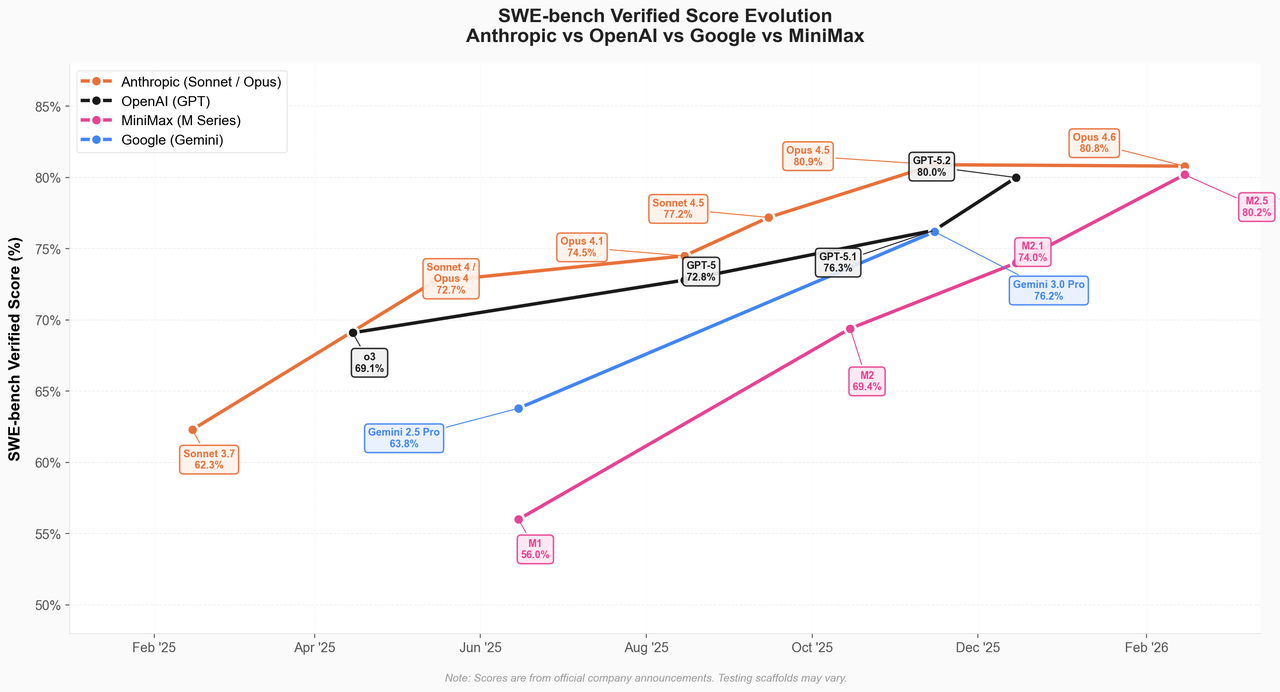
Over roughly three and a half months, MiniMax successively released M2, M2.1, and M2.5. MiniMax reports that on the SWE-Bench Verified benchmark, the M2-series' rate of progress has outpaced peers such as the Claude, GPT, and Gemini model families.
RL Scaling
One of the key drivers of these developments is the scaling of reinforcement learning. As MiniMax trains its models, it also uses them internally, and many of the tasks and workspaces across the company have been turned into RL training environments — hundreds of thousands to date. MiniMax also invested heavily in its agentic RL framework, algorithms, reward signals, and infrastructure to support continued scaling of RL training.
Forge –– Agent-Native RL Framework
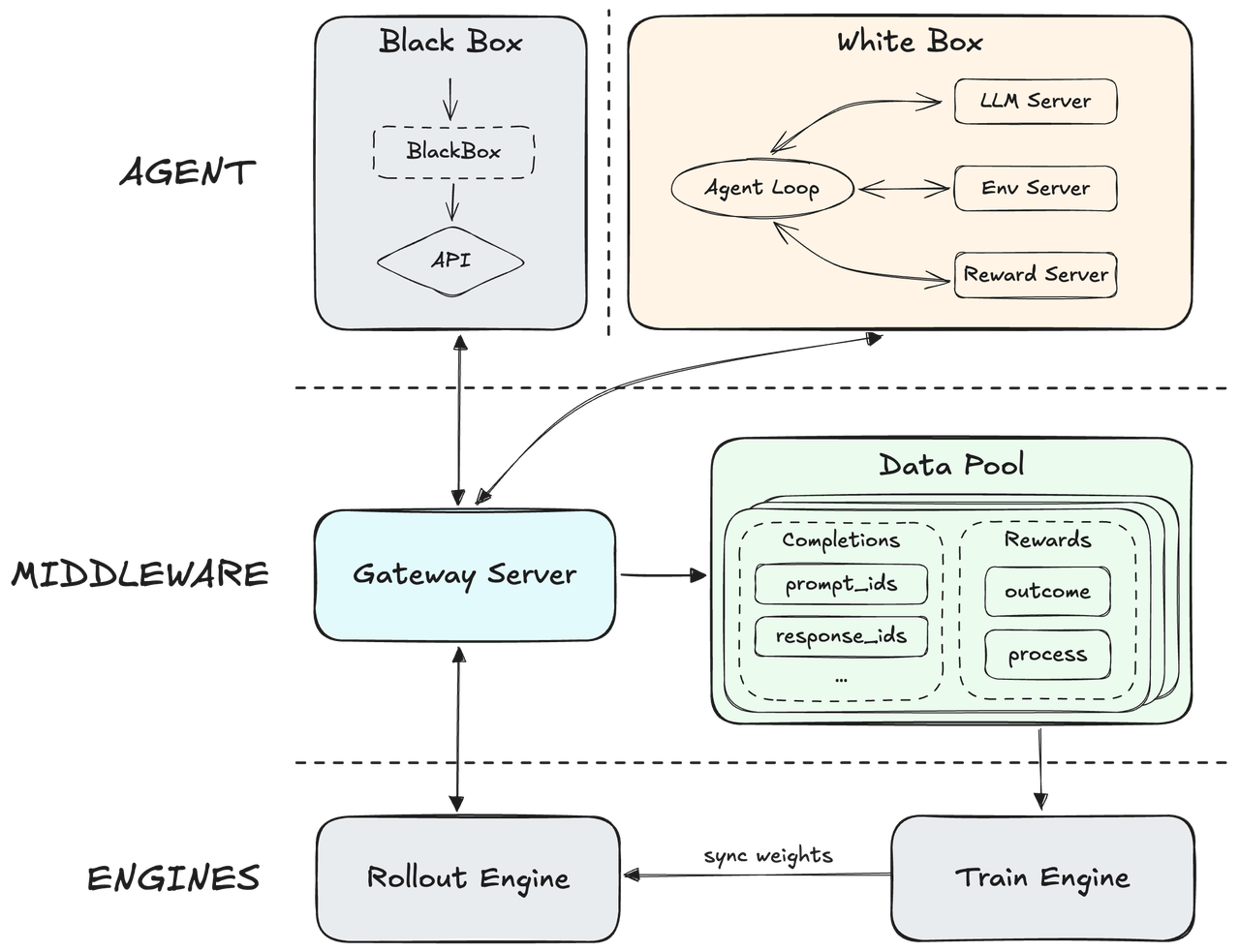
MiniMax designed an in-house agent-native RL framework called Forge, which introduces an intermediary layer that decouples the underlying training-inference engine from the agent, supporting the integration of arbitrary agents and improving the model's generalization across agent scaffolds and tools. To improve system throughput, MiniMax optimized asynchronous scheduling to balance throughput against sample off-policyness, and designed a tree-structured merging strategy for training samples, reporting roughly a 40x training speedup.
Agentic RL Algorithm and Reward Design
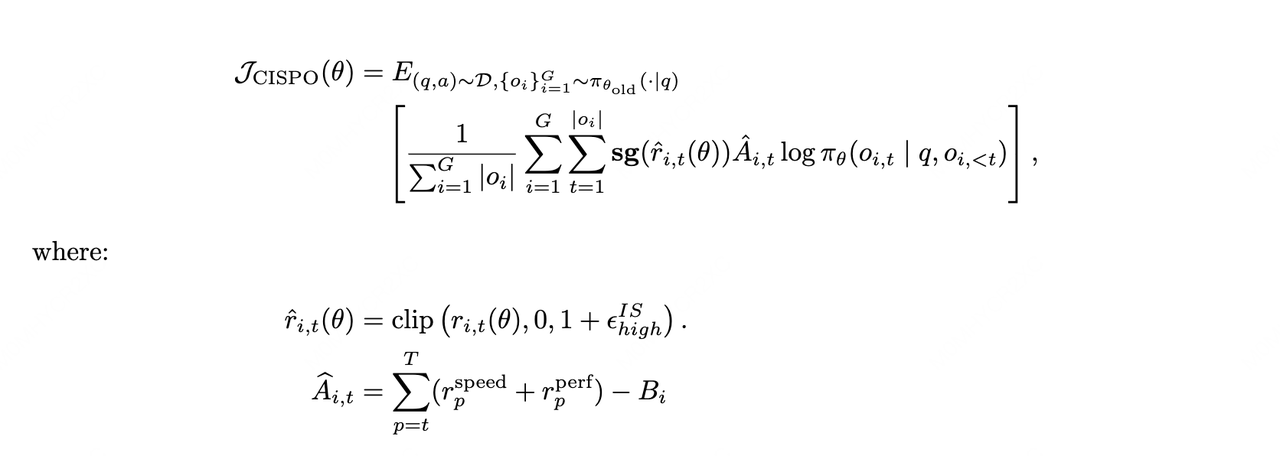
On the algorithm side, MiniMax continued using the CISPO algorithm it proposed earlier to keep MoE models stable during large-scale training. To address the credit-assignment challenge posed by long contexts in agent rollouts, MiniMax introduced a process reward mechanism for end-to-end monitoring of generation quality. To align with user experience, MiniMax also evaluated task completion time through agent trajectories, aiming for a good trade-off between model quality and response speed.
Benchmark Results
The following results are self-reported by MiniMax; figures for other models are drawn from their respective public reports.
| Benchmark | MiniMax-M2.5 | MiniMax-M2.1 | Claude Sonnet 4.5 | Claude Opus 4.5 | Claude Opus 4.6 | Gemini 3 Pro | GPT-5.2 (thinking) |
|---|---|---|---|---|---|---|---|
| AIME25 | 86.3 | 83.0 | 88.0 | 91.0 | 95.6 | 96.0 | 98.0 |
| GPQA-D | 85.2 | 83.0 | 83.0 | 87.0 | 90.0 | 91.0 | 90.0 |
| HLE w/o tools | 19.4 | 22.2 | 17.3 | 28.4 | 30.7 | 37.2 | 31.4 |
| SciCode | 44.4 | 41.0 | 45.0 | 50.0 | 52.0 | 56.0 | 52.0 |
| IFBench | 70.0 | 70.0 | 57.0 | 58.0 | 53.0 | 70.0 | 75.0 |
| AA-LCR | 69.5 | 62.0 | 66.0 | 74.0 | 71.0 | 71.0 | 73.0 |
Parameters
Inputs
prompt- (text): User-provided input can be a question, a request, or the context to be addressed. The system uses the prompt to analyze, infer, and generate a corresponding response.
Output
output- (text): The content generated after the token is the final answer that the model returns to the user.
Usage for developers
Please find below the details to track the information and access the code for processing the model on our platform.
Requirements
pip install -r requirements.txt
Code based on AIOZ structure
from transformers import AutoModelForCausalLM, AutoTokenizer, GenerationConfig
import os

...

def do_ai_task(
        prompt: Union[str, Path],
        model_storage_directory: Union[str, Path],
        device: Literal["cpu", "cuda", "gpu"] = "cpu",
        *args, **kwargs) -> Any:
    """Define AI task: load model, pre-process, post-process, etc ..."""
    # Define AI task workflow. Below is an example
    MODEL_PATH = os.path.join(model_storage_directory, "MiniMax-M2.5")

    model = AutoModelForCausalLM.from_pretrained(
        MODEL_PATH,
        device_map="auto",
        trust_remote_code=True,
    )
    tokenizer = AutoTokenizer.from_pretrained(MODEL_PATH)

    ...

    response = tokenizer.batch_decode(generated_ids)[0]

    return response
Reference
This repository is based on and inspired by MiniMax's work. We sincerely appreciate their generosity in sharing the model and code.
License
MiniMax-M2.5 is released by MiniMax under the MiniMax Model License. Commercial use, modification, and redistribution are permitted royalty-free, subject to conditions: redistributions must include a copy of the license and the required attribution notice (see NOTICE), modified files must be marked as changed, and all use must comply with the license's Prohibited Uses Policy (which bars military use, harm to minors, discrimination and hate speech, and other categories). The license also includes indemnification and litigation-termination clauses and is governed by the laws of Singapore.
License Notice: This model is distributed under a custom license (the MiniMax Model License), not a standard open-source license. Review the full license terms and its Prohibited Uses Policy, and confirm your use case with AIOZ AI before commercial deployment.
AIOZ AI redistributes this model under those terms. A full copy of the license is included in the LICENSE file, and the required attribution notice is provided in the NOTICE file.