Qwen-Image 2512
Qwen-Image-2512 is a 20B-parameter text-to-image generation model built on the Multimodal Diffusion Transformer (MMDiT) architecture with a frozen Qwen2.5-VL semantic encoder. It delivers photorealistic image generation, with improved human rendering, natural textures, and accurate text rendering in both English and Chinese for posters, infographics, and slides.


Qwen-Image 2512
Summary
Introduction
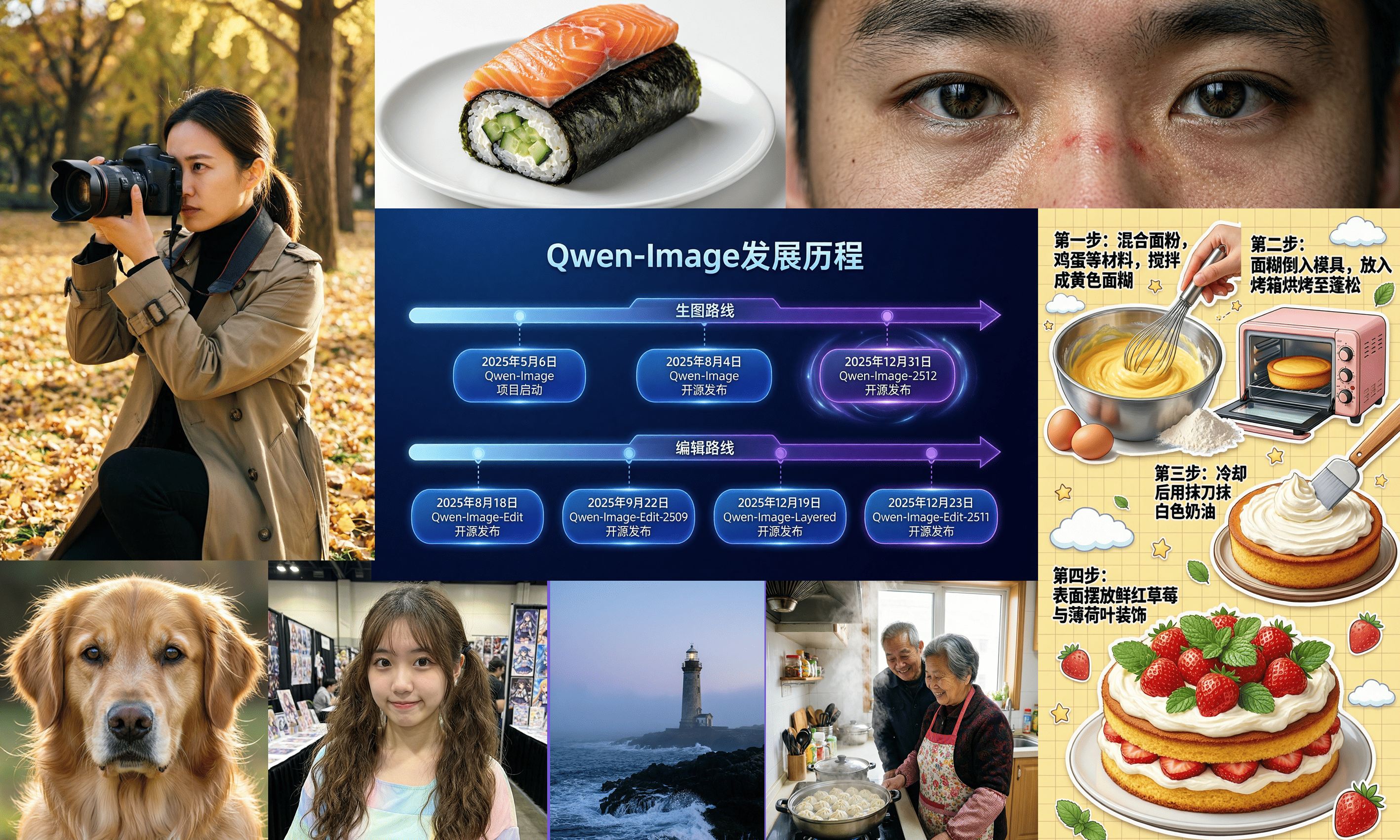
The author are excited to introduce Qwen-Image-2512, the December update of Qwen-Image’s text-to-image foundational model. You are welcome to try the latest model at Qwen Chat. Compared to the base Qwen-Image model released in August, Qwen-Image-2512 features the following key improvements:
- Enhanced Huamn Realism Qwen-Image-2512 significantly reduces the “AI-generated” look and substantially enhances overall image realism, especially for human subjects.
- Finer Natural Detail Qwen-Image-2512 delivers notably more detailed rendering of landscapes, animal fur, and other natural elements.
- Improved Text Rendering Qwen-Image-2512 improves the accuracy and quality of textual elements, achieving better layout and more faithful multimodal (text + image) composition.
Model Performance
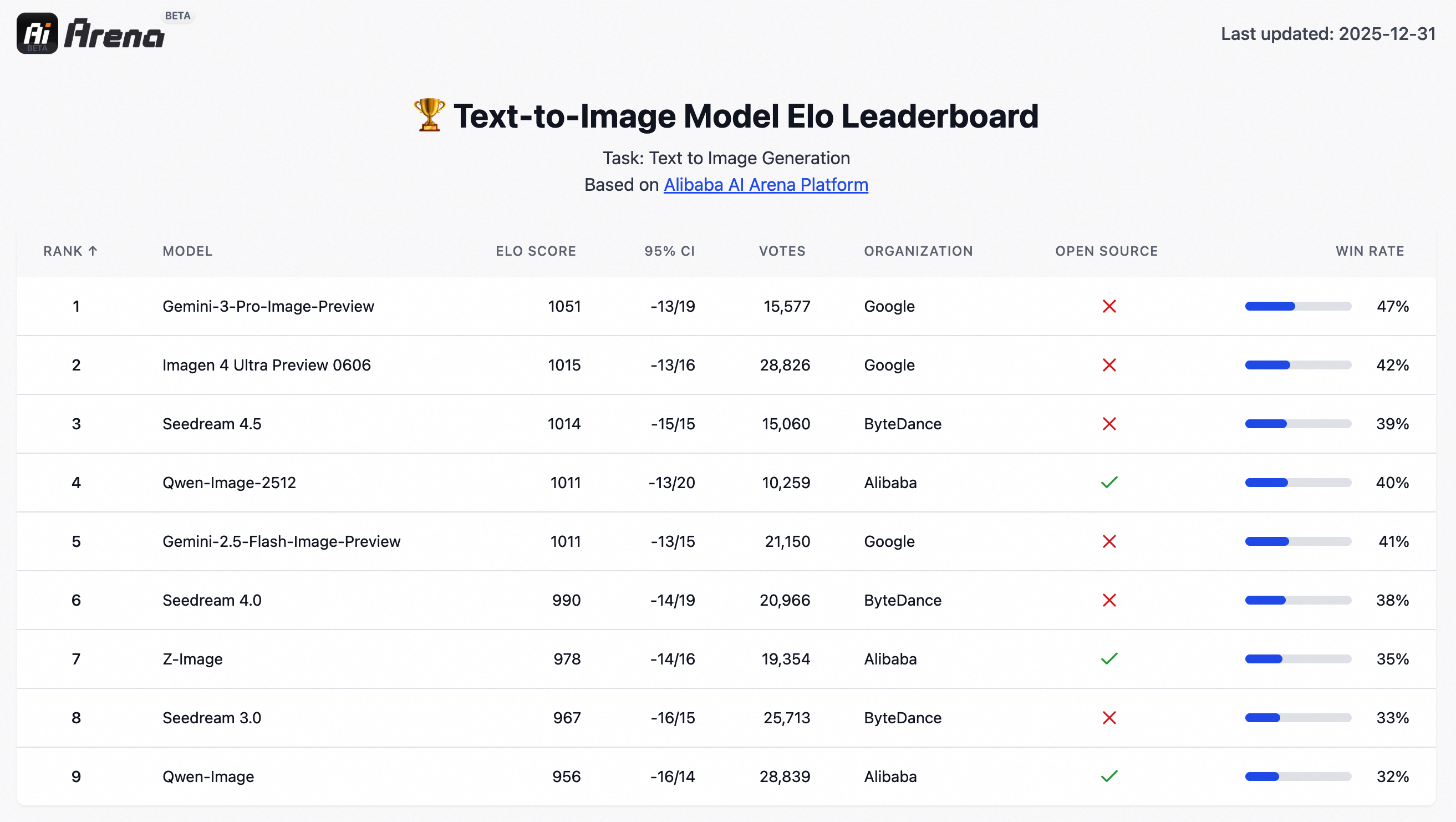
The author conducted over 10,000 rounds of blind model evaluations on AI Arena, and the results show that Qwen-Image-2512 is currently the strongest open-source model—while remaining highly competitive even among closed-source models.
Parameters
Inputs
prompt- (text): A natural language description of the image to be generated. It may include details about the scene, objects, style, lighting, and overall composition.height- (integer): The height of the generated image in pixels.width: (integer): The width of the generated image in pixels.steps: (integer): The number of inference steps used during image generation. Higher values typically improve image quality but increase generation time.cfg_scale: (float): Controls how closely the generated image follows the given prompt. Higher values make the output more aligned with the prompt but may reduce creativity.
Output
output_image- (image -.png): The generated image in .png format, created based on the provided prompt and generation parameters.
Usage for developers
Please find below the details to track the information and access the code for processing the model on our platform.
Requirements
pip install -r requirements
Code based on AIOZ structure
from diffusers import DiffusionPipeline
import torch
import os
...

def do_ai_task(
        prompt: str,
        negative_prompt: str,
        width: int,
        height: int,
        steps: int,
        cfg_scale: float,
        model_storage_directory: Union[str, Path],
        device: Literal["cpu", "cuda", "gpu"] = "cpu",
        *args, **kwargs) -> Any:
    """Define AI task: load model, pre-process, post-process, etc ..."""
    # Define AI task workflow. Below is an example

    # Load the pipeline
    if torch.cuda.is_available():
        torch_dtype = torch.bfloat16
        device = "cuda"
    else:
        torch_dtype = torch.float32
        device = "cpu"

    model_name = os.path.join(model_storage_directory, "Qwen-Image-2512")
    pipe = DiffusionPipeline.from_pretrained(model_name, torch_dtype=torch_dtype).to(device)

    ...

    image.save("output_image.png")
    output_image = open("output_image.png", "rb")  # io.BufferedReader
    return output_image
Reference
This repository is based on and inspired by Qwen's work. We sincerely appreciate their generosity in sharing the code.
License
We respect and comply with the terms of the author's license cited in the Reference section.
Citation
@misc{wu2025qwenimagetechnicalreport,
      title={Qwen-Image Technical Report},
      author={Chenfei Wu and Jiahao Li and Jingren Zhou and Junyang Lin and Kaiyuan Gao and Kun Yan and Sheng-ming Yin and Shuai Bai and Xiao Xu and Yilei Chen and Yuxiang Chen and Zecheng Tang and Zekai Zhang and Zhengyi Wang and An Yang and Bowen Yu and Chen Cheng and Dayiheng Liu and Deqing Li and Hang Zhang and Hao Meng and Hu Wei and Jingyuan Ni and Kai Chen and Kuan Cao and Liang Peng and Lin Qu and Minggang Wu and Peng Wang and Shuting Yu and Tingkun Wen and Wensen Feng and Xiaoxiao Xu and Yi Wang and Yichang Zhang and Yongqiang Zhu and Yujia Wu and Yuxuan Cai and Zenan Liu},
      year={2025},
      eprint={2508.02324},
      archivePrefix={arXiv},
      primaryClass={cs.CV},
      url={https://arxiv.org/abs/2508.02324},
}