Architectural Instance Segmentation
Segment architectural elements in a building image with a custom YOLOv8n segmentation checkpoint packaged for the AIOZ AI Node runtime.


Architectural Instance Segmentation
Segment architectural elements in a building image with a custom YOLOv8n segmentation checkpoint packaged for the AIOZ AI Node runtime.
Summary
- Introduction
- Model details
- Parameters
- Example
- Usage for developers
- Project structure
- Limitations
- References and attribution
- License
Introduction
This repository exposes the model through the same AIOZ entry-point convention as other AI Node packages: construct an InputObject, call my_ai_lib.run(input_obj), and receive an OutputObject. The workflow accepts one local image path or HTTP(S) image URL and returns a PNG with segmentation masks, class labels, confidence scores, and bounding boxes.
Model details
| Item | Value |
|---|---|
| Task | Instance segmentation |
| Architecture | YOLOv8n-seg |
| Framework | Ultralytics 8.3.233 |
| Checkpoint | models/instance_segmentation/best.pt |
| Training image size | 640 px |
The current checkpoint contains five classes:
| ID | Class |
|---|---|
| 0 | window |
| 1 | door |
| 2 | column |
| 3 | wall |
| 4 | beam |
Parameters
Input
input_image(image/string, required): Local path or HTTP(S) URL for a JPEG, PNG, WebP, or BMP image.confidence_threshold(float, optional): Minimum prediction confidence in the inclusive range[0, 1]. Default:0.25.iou_threshold(float, optional): Non-maximum suppression IoU threshold in the inclusive range[0, 1]. Default:0.70.device(string, optional):cpu,cuda, orgpu. The default iscuda; execution falls back to CPU when CUDA is unavailable.model_storage_directory(string, optional): Parent directory containinginstance_segmentation. AIOZ supplies this value at runtime.
Output
output_image(image): An annotated PNG namedarchitectural_segmentation.png, wrapped in an AIOZFileObject.
Example
| input | output |
|---|---|
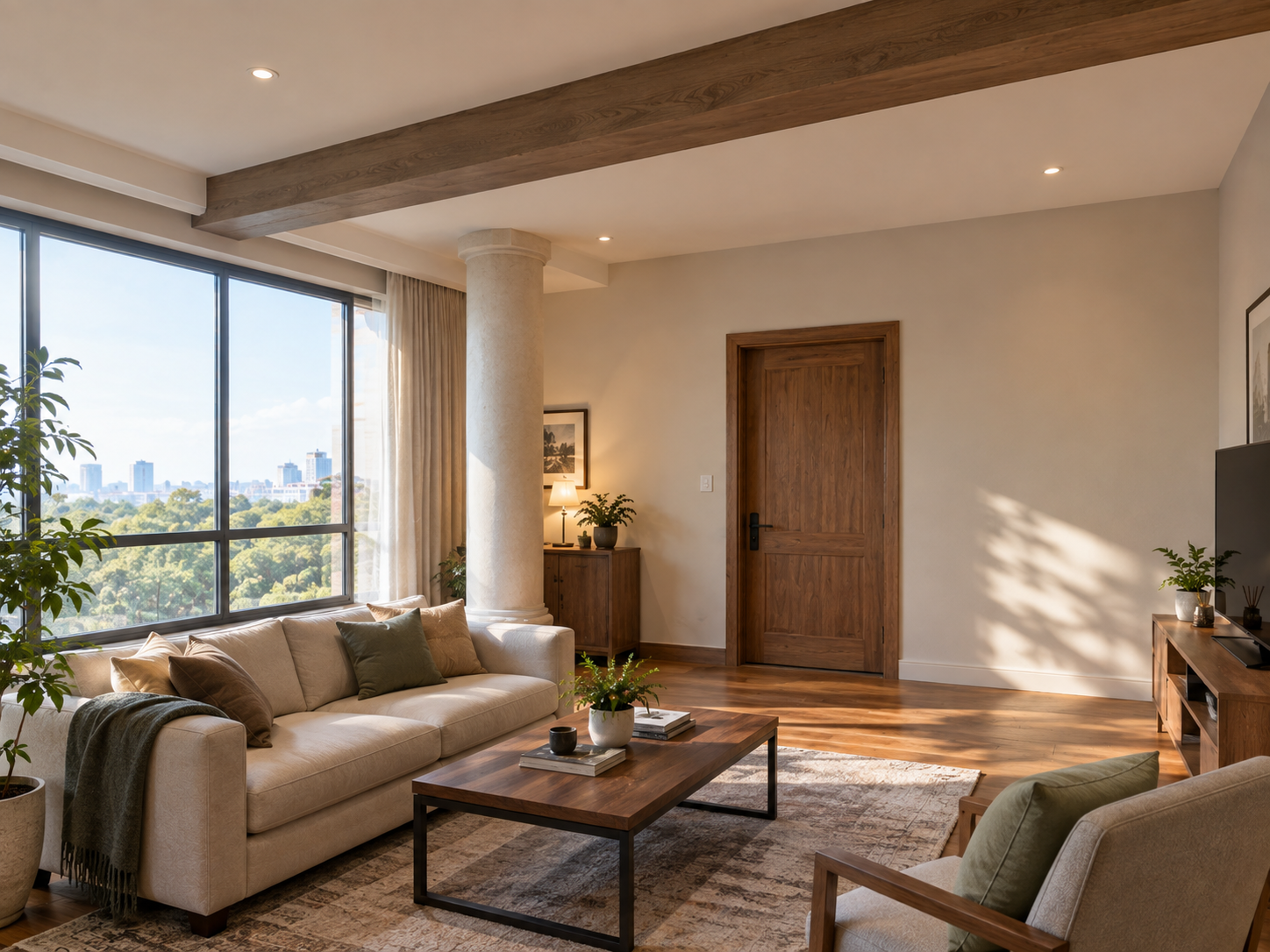 | 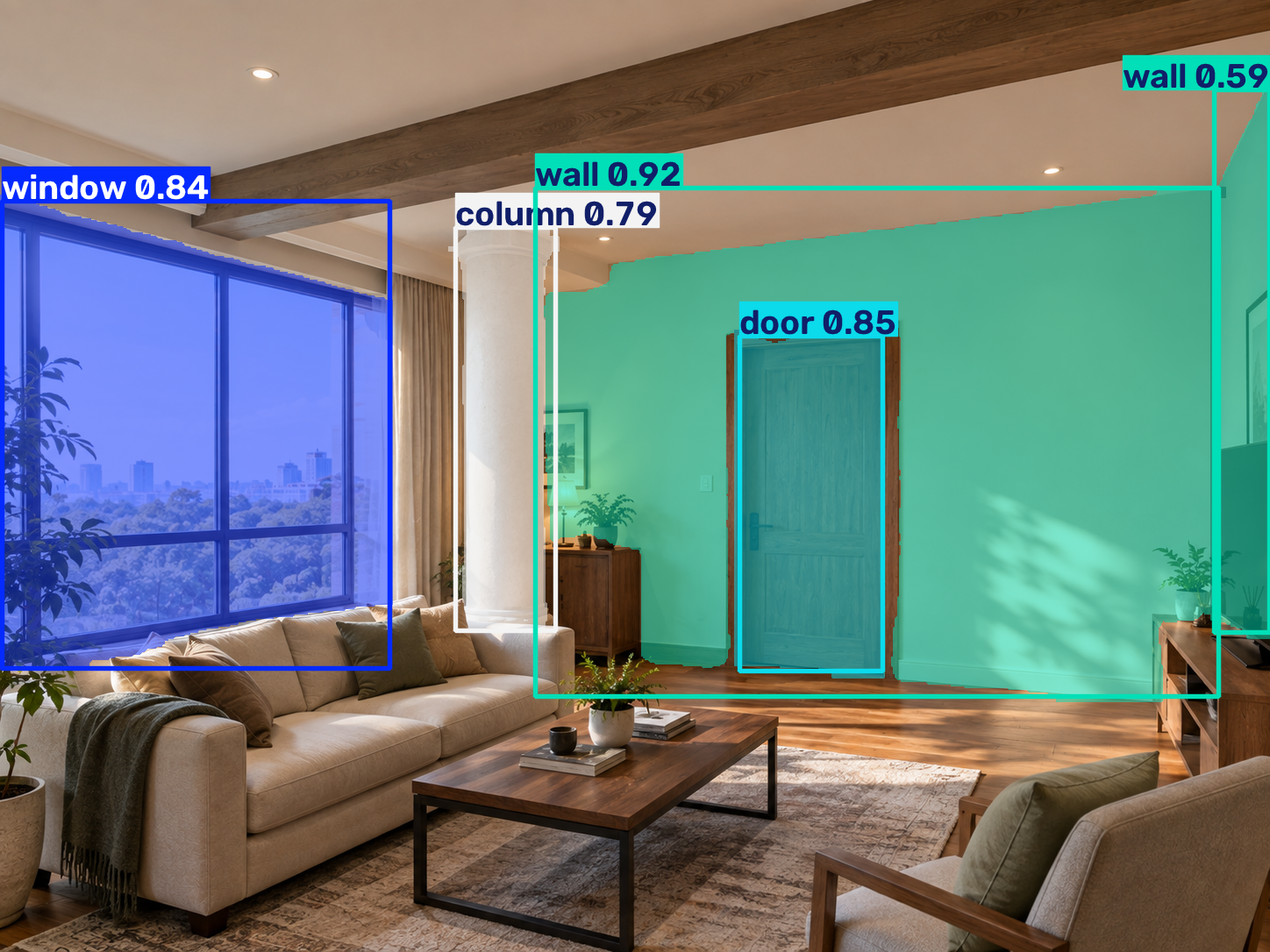 |
Usage for developers
Requirements
- Python 3.10 or newer
- Git LFS for the model checkpoint
- CUDA-capable GPU is optional
git lfs pull
pip install -r requirements.txt
Run the demo
python demo.py path/to/sample.png --output architectural_segmentation.png
Use CPU explicitly or adjust the inference thresholds when needed:
python demo.py path/to/sample.png --device cpu --confidence-threshold 0.35 --iou-threshold 0.60
Use the AIOZ entry point
import my_ai_lib
from aioz_ainode_adapter.schemas import InputObject

input_obj = InputObject(
    input_image="path/to/building.jpg",
    confidence_threshold=0.25,
    iou_threshold=0.70,
    device="cuda",
    model_storage_directory="models",
)
output_obj = my_ai_lib.run(input_obj)

print(output_obj.output_image.name)
The public API is my_ai_lib.run(input_obj). Task-specific schemas and inference logic live in my_ai_lib/run.py as MyInput, MyOutput, do_ai_task, and run.
Project structure
.
├── aioz_ainode_adapter/
├── assets/
│   └── sample.png
├── models/
│   └── instance_segmentation/
│       ├── args.yaml
│       └── best.pt
├── my_ai_lib/
│   ├── __init__.py
│   └── run.py
├── demo.py
├── README.md
└── requirements.txt
Limitations
- Accuracy can degrade on architectural styles, viewpoints, lighting conditions, or image quality that differ from the training data.
- Small, occluded, or visually ambiguous elements may be missed or merged.
- The confidence and IoU thresholds may need tuning for a particular deployment.
- The repository does not include evaluation data or benchmark metrics, so no accuracy claim is made here.
References and attribution
- Original model repository: TanTan2025/archivision-yolo, uploaded by Zilong Tan (
TanTan2025). - The original model card attributes the model to the ArchiVision Team (2025).
- Runtime and model architecture: Ultralytics YOLOv8.
- Playground sample: A building facade by Maximden, dedicated to the public domain under CC0 1.0.
License
The original model card declared the repository as MIT licensed. The current best.pt checkpoint also embeds an Ultralytics AGPL-3.0 license notice. Both notices and the original attribution are preserved here; consult the Ultralytics licensing terms and confirm the model-specific terms with the original publisher before redistribution or production use.