All Models
Qwen3-0.6B
Qwen3-0.6B is a compact 0.6B-parameter causal language model from Alibaba Cloud’s Qwen team. Featuring a hybrid Thinking/Non-Thinking mode, it balances deep reasoning with fast, efficient responses. With support for a 32K token context window, over 100 languages, and native tool-calling via the Qwen-Agent framework, it is well-suited for lightweight chatbots, math/code reasoning, and agentic applications.
by @AIOZAI


Handwritten Digit Recognition Challenge
Baseline source code for Handwritten Digit Recognition Challenge
by @AIOZAI
Ministral-3 3B-Base 2512
Ministral 3 3B Base 2512 is a compact multimodal foundation model from Mistral AI. It combines a 3.4B-parameter language decoder with a 0.4B frozen vision encoder for native image understanding. Distilled from the 24B Mistral Small 3.1 through an iterative “Cascade Distillation” process, it preserves much of its teacher model’s capability while supporting a 256K token context window via YaRN RoPE scaling.
by @AIOZAI
MiMo-7B-Base
A 7B-parameter decoder-only language model developed by Xiaomi. Trained from scratch for mathematical and coding reasoning, it serves as the foundational checkpoint of the MiMo-7B series, providing a strong base for fine-tuning and reinforcement learning.
by @AIOZAI
Granite-4.0-Micro
A 3B-parameter long-context instruct model from IBM, finetuned for enhanced instruction following and tool-calling. Supports 12 languages including English, Chinese, Arabic, and Japanese. Built on a dense Transformer with GQA, RoPE, SwiGLU, and 128K context length. Trained using SFT, RL alignment, and model merging techniques for enterprise applications.
by @AIOZAI
Qwen-Image 2512
Qwen-Image-2512 is a 20B-parameter text-to-image generation model built on the Multimodal Diffusion Transformer (MMDiT) architecture with a frozen Qwen2.5-VL semantic encoder. It delivers photorealistic image generation, with improved human rendering, natural textures, and accurate text rendering in both English and Chinese for posters, infographics, and slides.
by @AIOZAI
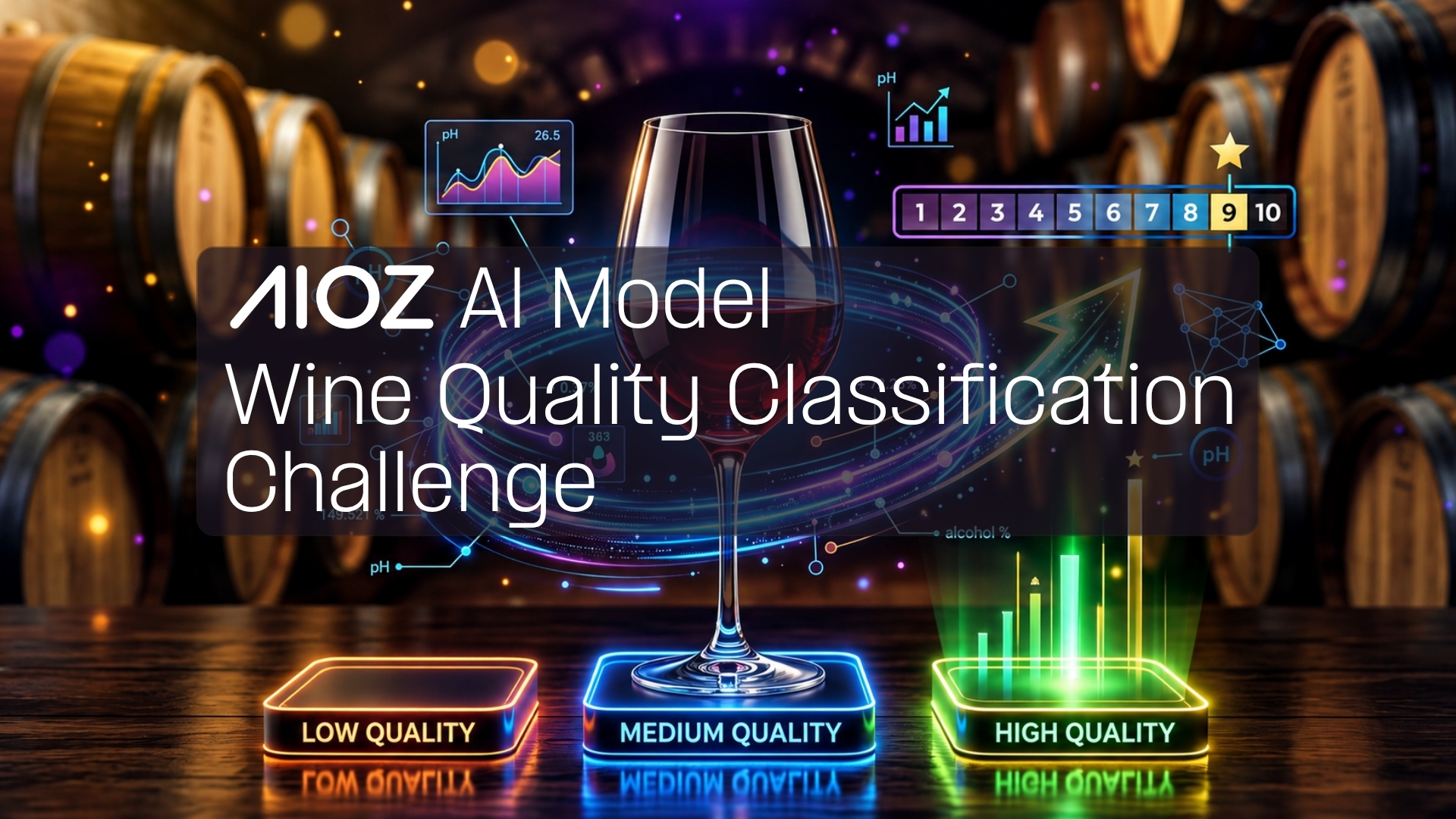
Wine Quality Classification Challenge
Baseline source code for Wine Quality Classification Challenge
by @AIOZAI
Wan2.2-Animate-14B
A character animation and replacement video model: give it one character image and a driving video, and it transfers full-body motion and facial expression onto your character in either animation or replacement mode.
by @AIOZAI
MiniMax-M2.5
A large agentic model built for coding, tool use, search, and office work, reporting strong results on SWE-Bench Verified and other agentic benchmarks.
by @AIOZAI
Olmo-3.1-32B-Instruct
A 32B instruction-tuned model from Ai2, built for reasoning, coding, and instruction-following, and released as a fully open model with public code, checkpoints, and training data.
by @AIOZAI
SmolLM3
A compact 3B model that punches above its size: dual-mode reasoning, six languages, and up to 128k-token context, released fully open with weights, data mixture, and training details.
by @AIOZAI
Smoker Classification Challenge
Baseline source code for Smoker Classification Challenge
by @AIOZAI
Devstral Small 2 24B Instruct 2512
An agentic coding model that explores codebases, edits across multiple files, and drives software-engineering agents — light enough to run on a single GPU, with a 256k context window and vision support.
by @AIOZAI
Qwen2.5-Omni-7B
Qwen2.5-Omni-7B is an end-to-end multimodal foundation model that perceives text, images, audio, and video while streaming both text and natural speech responses in real time. Built on the novel Thinker–Talker architecture with TMRoPE time-aligned multimodal position embeddings, it delivers state-of-the-art results on OmniBench and matches or surpasses similarly sized single-modality models across speech, vision, and audio reasoning benchmarks. Its end-to-end speech-instruction-following ability rivals its text-input performance on standards such as MMLU and GSM8K.
by @AIOZAI
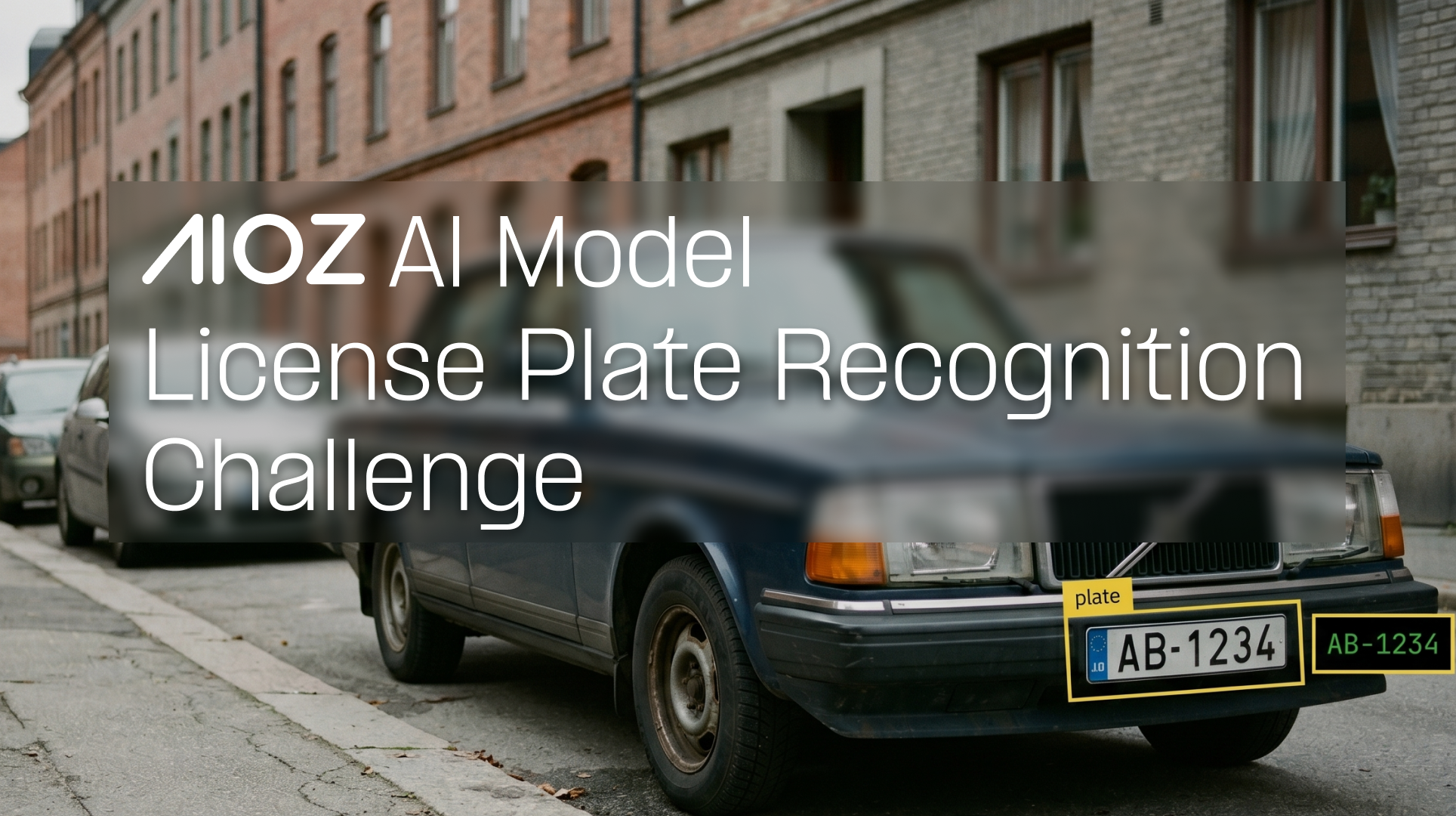
License Plate Recognition Challenge
Model for License Plate Recognition Challenge
by @AIOZAI
Z-Image Turbo
Z-Image-Turbo is a 6B-parameter text-to-image diffusion model distilled from the Z-Image foundation model, producing high-fidelity images in only 8 NFEs (Number of Function Evaluations). It delivers sub-second inference latency on H800-class GPUs and fits within 16 GB of VRAM on consumer hardware, while preserving strong photorealism, bilingual (English/Chinese) text rendering, and reliable instruction following.
by @AIOZAI
QwQ-32B
QwQ-32B is a 32.5B-parameter causal reasoning model from the Qwen series, post-trained with supervised fine-tuning and reinforcement learning to think explicitly before answering. Despite its mid-range size, it delivers performance competitive with leading reasoning systems such as DeepSeek-R1 and o1-mini, particularly on hard math, coding, and multi-step problems. It supports a native 131,072-token context (with YaRN scaling for inputs beyond 8,192 tokens) and is best driven with non-greedy sampling (Temperature 0.6, TopP 0.95, TopK 20–40).
by @AIOZAI
Phi-4
Phi-4 is Microsoft's 14B-parameter dense decoder-only language model, trained on ~9.8T tokens of synthetic, textbook-quality, and curated web data with a 16K-token context window. It is engineered for reasoning and logic in memory- or latency-constrained deployments, matching or surpassing far larger models on math (MATH: 80.4) and science (GPQA: 56.1) benchmarks. Released under the permissive MIT license with SFT + DPO alignment for instruction following and safety.
by @AIOZAI
Qwen3-Coder-Next
Qwen3-Coder-Next is an open-weight coding model from the Qwen team that activates just 3B of its 80B parameters per token, matching the performance of models 10–20× larger at a fraction of the inference cost. It pairs a hybrid Gated DeltaNet + Gated Attention MoE architecture with a native 262,144-token context, and is purpose-built for agentic coding tasks such as long-horizon reasoning, tool use, and failure recovery, with out-of-the-box support for Claude Code, Qwen Code, Qoder, Kilo, Trae, and Cline.
by @AIOZAI
Spaceship Titanic Prediction Challenge
Model for Spaceship Titanic Prediction Challenge
by @AIOZAI